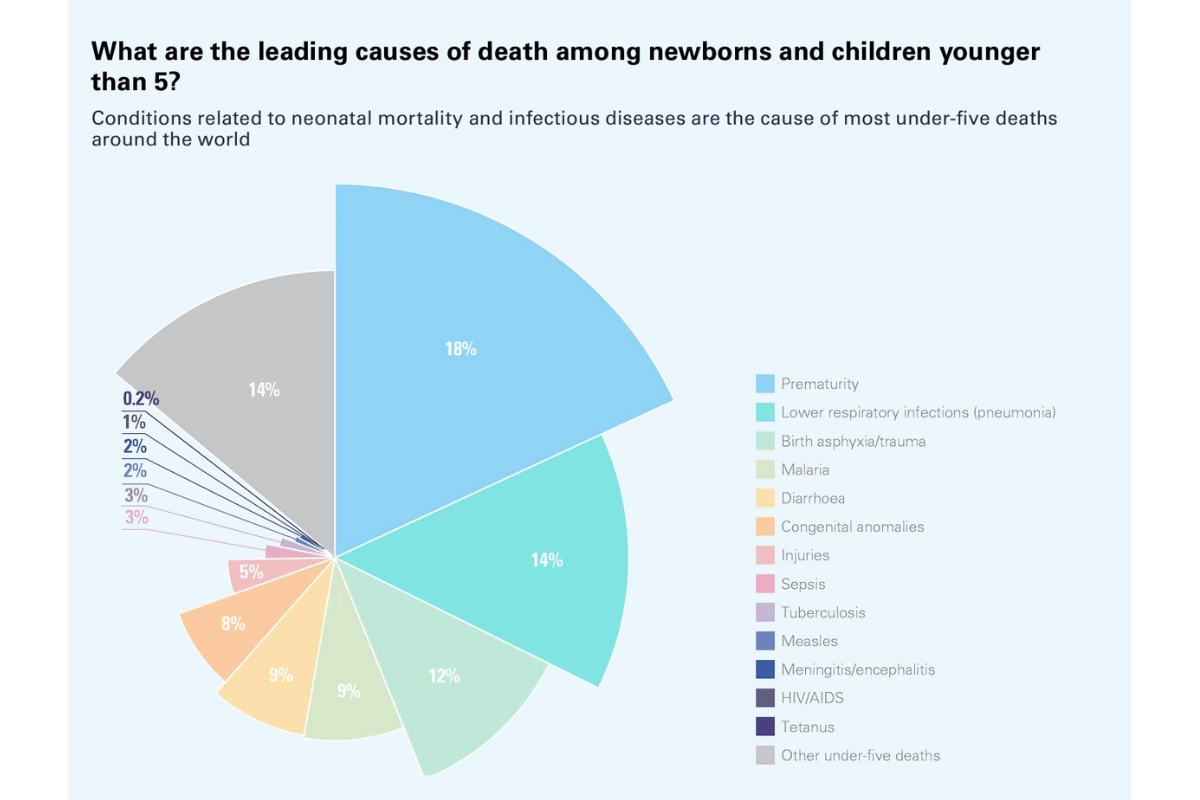
In March 2024 the United Nations Inter-agency Group for Child Mortality Estimation (UN IGME) shared a report that indicates that the number of children who died before their fifth birthday reached a “historic low” in 2022. The number dropped to 4.9 million, which has been described by health leaders as “progress”. However, there is evidently more to be done to ensure that more children survive early childhood and go on to live healthy and happy lives.
8 facts
The report begins with “8 things to know about newborn, child, adolescent, and youth mortality”.
- Good progress has led to fewer children dying before turning 5 than ever recorded.
- The annual death toll among children, adolescents, and youth remains unacceptably high.
- Children endure unequal chances of survival based on where they live, their socio-economic group, and if they live in a fragile and conflict-affected setting.
- Unless urgent action is taken to end preventable newborn and child deaths, many low- and lower-middle-income countries will not meet the Sustainable Development Goal (SDG) targets for newborn and under-five mortality and 35 million under age 5 will die before 2030.
- Progress is possible, even in low- and lower-middle-income countries.
- Investments at local, subnational, and national levels must be made to ensure proven interventions are available and accessible in every community, particularly where newborns and children are most at risk.
- Data are least available in the places where children face the highest risks.
- Global action is needed now to ensure progress – not complacency – defines the remaining years of the SDG era.
Data highlights from the report
- In 2022 neonatal deaths reached 2.3 million, which means one death every 14 seconds.
- In 2022 deaths of children under 5 reached 4.9 million, which means one death every 6 seconds.
- In 2022 adolescent deaths reached 0.9 million, which means one death every 35 seconds.
Comparing previous recorded years, the report tracks total deaths for earlier decades. From 1990-1999 there were 115 million deaths; from 2000-2009 there were 85 million deaths; from 2010-2019 there were 62 million deaths. Between 2020 and 2022 there have been 15 million deaths.
The risk of death for children under 5 was 18 times greater in sub-Saharan Africa than in Australia and New Zealand. The country with highest risk of mortality for children under 5 had 80 times greater risk than the country with the lowest risk.
- 4 out of 5 deaths in children under 5 occurred in sub-Saharan Africa and Southern Asia, but only 3 in 5 live births occurred in those regions.
- Sub-Saharan Africa accounted for 57% of global deaths under 5, but only accounted for 30% of global live births.
- Southern Asia accounted for a further 26% of global deaths under 5, but only accounted or 27% of global live births.
SDGs
The report states that, without “urgent action”, there is a risk of missing the SDG mortality targets of 25 or fewer under-5 deaths per 1,000 live births by 2030 (SDG 3.2.1) and 12 or fewer neonatal deaths per 1,000 live births by 2030 (SDG 3.2.2). At present, 59 countries are at risk of missing the SDG under-5 mortality target and 64 countries are at risk of missing the SDG neonatal mortality target.
- If we continue at the current rate, 35 million children under 5 are projected to die by 2030.
- Furthermore, 16 million children, adolescents, and youth between 5-24-years-old are projected to die by 2030.
- 9 million under-5 deaths could be prevented by accelerating progress to meet the SDG target in the countries at risk of missing the target.
Experts weigh in
UNICEF Executive Director Catherine Russell recognised that “behind these numbers lie the stories of midwives and skilled health personnel” who help deliver newborns, alongside the health workers and community health workers who provide vaccination and health and nutrition support.
“Through decades of commitment by individuals, communities, and nations to reach children with low-cost, quality, and effective health services, we‘ve shown that we have the knowledge and tools to save lives.”
However, Dr Tedros Adhanom Ghebreyesus, WHO Director General, emphasised that despite “welcome progress” there are still “millions of families” who “suffer the devastating heartbreak of losing a child”.
“Where a child is born should not dictate whether they live or die. It is critical to improve access to quality health services for every woman and child, including during in emergencies and in remote areas.”
Dr Juan Pablo Uribe, Global Director for Health, Nutrition, and Population, World Bank, and Director, Global Financing Facility for Women, Children, and Adolescents, commented that the report is an “important milestone”.
“But this is simply not enough. We need to accelerate progress with more investments, collaboration, and focus to end preventable child deaths and honour our global commitment. We owe it to all children to ensure they have access to the same health care and opportunities, regardless of where they are born.”
UN Under-Secretary-General for Economic and Social Affairs agreed that the data are “important to track progress”, but also emphasise a need for more work.
“They should also remind us that further efforts and investments are needed to reduce inequities and end preventable deaths among newborns, children, and youth worldwide.”
The full report can be accessed on the UN IGME page here. How might vaccination strategies factor into efforts to reduce the number of deaths and meet SDGs? For more on this, join us at the Congress in Washington this April or subscribe to our newsletters here.