by Charlotte Kilpatrick | Sep 12, 2024 | Global Health |
In September 2024, Merck (MSD) announced positive top-line results from its pivotal Phase III trial evaluating the company’s 9-valent Human Papillomavirus (HPV) vaccine, GARDASIL 9, in young males in Japan. The trial met its primary and secondary endpoints, proving that administration of a 3-dose regimen of GARDASIL 9 reduced the combined incidence of anogenital persistent infection caused by 9 types of HPV compared to a placebo. Merck will share the data with regulatory authorities in Japan and other countries to support licensure for use in males.
V503-064
V503-064 is a Phase III, double-blind, placebo-controlled clinical study to evaluate the safety, tolerability, and efficacy of GARDASIL 9 (V503) in preventing HPV-related anogenital persistent infection in Japanese males between the ages of 16 and 26. It enrolled 1,059 participants. The primary efficacy objective was to demonstrate reduction in the incidence of HPV 6/11/16/18-related 6-month anogenital persistent infection. The secondary efficacy objective was to demonstrate reduction in the incidence of HPV 31/33/45/52/58-related 6-month anogenital persistent infection.
Dr Eliav Barr, senior vice president, head of global clinical development and chief medical officer, Merck Research Laboratories, highlighted that “a decade after the first approval of GARDASIL 9, Merck continues to evaluate this important vaccine in additional patient populations”. Dr Barr emphasised Merck’s commitment to “helping prevent certain HPV-related cancers through broad and equitable access globally”.
“These data build on the clinical efficacy of GARDASIL 9 for the prevention of persistent infection in males and can potentially make a significant impact in addressing the global burden of certain HPV-related cancers and diseases.”
Merck’s clinical development programme evaluating GARDASIL 9 in males includes an ongoing confirmatory Phase III trial evaluating efficacy in preventing HPV oral persistent infection to support effectiveness against HPV-related oropharyngeal and other head and neck cancers.
For the latest vaccine research updates at the Congress in Barcelona this October, get your tickets to join us here and don’t forget to subscribe to our weekly newsletters here.
by Charlotte Kilpatrick | Aug 22, 2024 | Global Health |
A paper in The Lancet Infectious Diseases in August 2024 presents the results of an observational study during the Ebola epidemic in the Democratic Republic of the Congo (DRC). The researchers evaluated the effectiveness of the only WHO prequalified vaccine recommended for use in outbreaks of Ebola virus, the recombinant vesicular stomatitis virus-Zaire Ebola virus (rVSV-ZEBOV) vaccine. This is the first work to provide estimates of the real-world effectiveness of the vaccine and confirms that it is “highly protective” against Ebola virus disease.
A tool against Ebola
Ebolaviruses are endemic in the Democratic Republic of the Congo (DRC), which had reported15 outbreaks by March 2024. The 10th of these was confirmed in August 2018 and was in northeastern provinces of North Kivu and Ituri, characterised by “chronic insecurity and conflict, political instability, mistrust in government, and high population mobility”. At the end of the outbreak in June 2020, 3,470 cases and 2,287 deaths were recorded; it was the largest reported outbreak in the country and the second-largest outbreak worldwide.
Merck’s recombinant vesicular stomatitis virus-Zaire Ebola virus single-dose vaccine (rVSV-ZEBOV, known as Ervebo) received WHO prequalification in November 2019 and is recommended by WHO’s Strategic Advisory Group of Experts on Immunisation (SAGE) for individuals at risk of exposure during outbreaks. It was deployed in the 10th ebolavirus outbreak in the DRC under the Expanded Access framework following the recommended strategy based on reactive ring vaccination and targeting of at-risk individuals. This was expanded under SAGE guidelines to include pregnant and breastfeeding women and infants between 6 and 12 months.
The study
The authors sought to retrospectively estimate the effectiveness of rVSV-ZEBOV vaccination against Ebola virus disease during the 2018-2020 outbreak in the DRC. They used a test-negative design; the study population comprised eligible individuals who were reported as having suspected Ebola virus disease at Ebola virus disease facilities. Standardised patient data were recorded by data managers at each Ebola virus disease facility and compiled into a centralised case management database weekly.
60,246 suspected cases were assessed for eligibility, among which 26,438 were eligible for inclusion. Among eligible individuals, 1,273 (4.8%) were Ebola virus disease-positive (cases) and 25,165 (95.2%) were Ebola virus disease-negative (controls). 333 (26.2%) of the cases were reported as being vaccinated; most were vaccinated fewer than 10 days before symptom onset. 4,855 (19.3%) of the controls were reported as being vaccinated.
The effectiveness of rVSV-ZEBOV vaccination against Ebola virus disease was estimated to be 84% at 10 or more days after vaccination. Stratified by sex, effectiveness was 80% for females and 86% for males. Stratified by age, effectiveness was 80% for children younger than 15 years, and 83% for adults. The effectiveness estimate was compatible with results from the Ebola Ça Suffit! ring vaccination trial but are lower than preliminary estimates from the 2018-2020 outbreak.
“Our results indicate that rVSV-ZEBOV is highly protective against Ebola virus disease and support its reactive, targeted use in people at risk of exposure during Ebola virus disease outbreaks.”
Dr Sophie Meakin, epidemiologist with Epicentre MSF, states that the study “dispels uncertainties about the vaccine’s actual effectiveness”.
“It is the first published study to evaluate the effectiveness of the rVSVΔG-ZEBOV-GP vaccine outside of a clinical trial. It was carried out during the second largest Ebola epidemic on record.”
The authors highlight the need for further work on the duration of protection and efficacy in populations that are susceptible to severe disease and outcomes. Professor Steve Ahuka, head of virology at Institut National de Recherche Biomédicale (INRB) and medical professor at the University of Kinshasa, commented on the importance of data collection during epidemics, amid ongoing challenges.
“These are unique opportunities to deepen our knowledge of often rare diseases, and thus improve the management of future epidemics, develop new control tools, and determine the best strategies for using them effectively.”
To join us at the Congress in Barcelona and participate in discussions about safety and effectiveness evaluations of vaccines deployed in emergencies, get your tickets here. Don’t forget to subscribe to our weekly newsletters for more vaccine updates.
by Charlotte Kilpatrick | Jun 26, 2024 | Global Health |
In June 2024 Merck Animal Health (known as MSD Animal Health outside the US and Canada) announced that the USDA has approved NOBIVAC NXT Canine Flu H3N2, its “next-level solution” to protect dogs against the “ongoing threat” of canine influenza. The product is expected to be available at veterinary clinicals and hospitals nationwide later in the summer. Canine influenza, also known as dog flu, is a serious respiratory illness that transmits easily between dogs. The vaccine leverages RNA-partcile technology to enable a precise immune response against a range of viral and bacterial pathogens.
NOBIVAC NXT Canine Flu H3N2
NOBIVAC NXT Canine Flu H3N2 is the “first and only” canine influenza vaccine based on Merck Animal Health’s RNA-particle technology platform. It is a nonadjuvanted, low volume 0.5 mL dose vaccine that “harnesses the natural ability of the immune system to generate a robust response without compromising comfort or safety”. It is indicated for the vaccination of healthy dogs aged 8 weeks or older.
In response to the emergence of the canine influenza H3N2 epidemic in the US in 2015, Merck Animal Health made its monovalent H3N2 vaccine available to protect dogs against the disease. In 2016 it received a fully licensed bivalent and monovalent H3N2 vaccine.
A groundbreaking advancement
Dr Christine Royal, vice president, companion animal and equine business unit, Merck Animal Health, is “beyond proud” that the team is introducing the latest vaccine with “NXT-level technology”.
“This is a groundbreaking advancement in our vaccine pipeline designed to meet the evolving needs of veterinarians and pet owners alike. With over 70 years of innovation and commitment to animal health, our new NOBOVAC NXT technology will continue to lead the way in providing breakthrough solutions for the prevention of disease in animals.”
Dr Ian Tarpey, vice president, research and development, Merck Animal Health, stated that “as a leader in innovation and trusted advocate for disease prevention”, the team is using its leadership and expertise to “make medicines that help keep pets safe”.
“The NOBIVAC NXT innovation represents a major advancement in vaccine technology and furthers our commitment to animal care by helping veterinarians protect pets from significant disease and ultimately, improve their lives by preventing health issues.”
Dr Meg Conlon, executive director, veterinary professional services, Merck Animal Health, emphasised that “vaccination is the best form of protection against this highly transmissible disease” that can have a “widespread impact”.
“Pets have become part of the family and are integrated into so many aspects of our lives, which makes vaccination even more crucial. At Merck Animal Health, we continue to stress the importance of preventative care to keep our beloved pets healthy and protected from potential illness.”
For more on veterinary vaccines and protecting animal health, why not join us at the Congress in Barcelona this October? Don’t forget to subscribe to our weekly newsletters here.
by Charlotte Kilpatrick | Jun 18, 2024 | Technology |
In June 2024 Merck (known as MSD outside the US and Canada) announced that the FDA has approved CAPVAXIVE for the prevention of invasive disease and pneumonia caused by specific Streptococcus pneumoniae serotypes that cause most invasive pneumococcal disease (IPD) cases. The vaccine has been approved for use in adults and targets serotypes 3, 6A, 7F, 8, 9N, 10A, 11A, 12F, 15A, 15C, 16F, 17F, 19A, 20A, 22F, 23A, 23B, 24F, 31, 33F and 35B. The CDC’s Advisory Committee on Immunisation Practices is expected to meet this month to discuss recommendations for the use of CAPVAXIVE in adults.
Targeting new serotypes
Merck used CDC data to inform serotype selection. In adults aged 50 and older, CAPVAXIVE covers the serotypes responsible for around 84% of IPD cases, which compares to approximately the 52% covered by PCV20 (pneumococcal 20-valent conjugate vaccine). In adults aged 65 and older, CAPVAXIVE covers the serotypes responsible for approximately 85% of IPD cases, compared to around 51% covered by PCV20.
CAPVAXIVE incorporates eight unique serotypes that are not covered by other currently approved pneumococcal vaccines: 15A, 15C, 16F, 23A, 23B, 24F, 31, and 35B. Dr Walter Orenstein, professor emeritus of medicine, epidemiology, global health, and paediatrics at Emory University and member of Merck’s Scientific Advisory Committee, suggested that “complications from invasive pneumococcal disease can lead to hospitalisation, organ damage, and even death”.
“CAPVAXIVE is designed to include the serotypes that cause the majority of invasive pneumococcal disease in adults, helping to protect adults against invasive pneumococcal disease and pneumococcal pneumonia.”
Dr Dean Y. Li, president, Merck Research Laboratories, stated that the approval is a “testament to our population-specific strategy behind CAPVAXIVE, which demonstrated robust immunogenicity in a range of adult populations” and is “driven by a deep understanding of pneumococcal disease”.
“We are proud to provide CAPVAXIVE as a new option specifically designed to help protect against the majority of invasive pneumococcal disease-causing serotypes in adults.”
For more vaccine updates don’t forget to subscribe to our weekly newsletters here.
by Charlotte Kilpatrick | Jun 4, 2024 | Therapeutic |
In June 2024 Moderna and Merck announced the first presentation of results from a planned analysis from the Phase IIb randomised KEYNOTE-942/mRNA-4157-P201 study. The study evaluates mRNA-4157 (V940) in combination with KEYTRUDA in patients with resected high-risk melanoma (stage III/IV) after complete resection. Moderna states that, with a median follow-up of around three years (34.9 months), adjuvant treatment with mRNA-4157 (V940) in combination with KEYTRUDA “continued to demonstrate a clinically meaningful and durable improvement” in recurrence-free survival (RFS), which was the primary endpoint of the study. Risk of recurrence or death was reduced by 49% when compared with KEYTRUDA alone. The combination also “continued to demonstrate a meaningful improvement” in distant metastasis-free survival (DMFS), reducing the risk of developing distant metastasis or death by 62%.
Study highlights
Data from an exploratory subgroup analysis of the study showed that improvement in RFS was observed in the combination approach compared to KEYTRUDA alone regardless of tumour mutational burden (TMB) or programmed death-ligand 1 (PD-L1) status. The RFS benefit of the combination compared to KEYTRUDA alone was maintained across both TMB high, TMB non-high, PD-L1 positive, PD-L1 negative, and circulating tumour DNA (ctDNA) negative subpopulations. ctDNA positive HR was not estimable due to the small sample size. There were “no significant associations” between individual human leukocyte antigen (HLA) alleles and RFS observed for mRNA-4157 (V940) in combination with KEYTRUDA.
“The exploratory endpoint of overall survival (OS) favoured mRNA-4157 (V940) in combination with KEYTRUDA compared to KEYTRUDA alone, with a 2.5-year OS rate of 96.0% vs 90.2%.”
The safety profile of the combination of mRNA-4157 (V940) and KEYTRUDA “remains consistent with the primary analysis” with the most common adverse events being fatigue (60.6%), injection site pain (56.7%), and chills (49.0%).
Encouraging results
Dr Kyle Holen, Moderna’s Senior Vice President and Head of Development, Therapeutics and Oncology, is “encouraged by the latest results”.
“These data highlight the sustained benefit in RFS and DMFS of mRNA-4157 (V940) as adjuvant treatment in combination with KEYTRUDA in people with resected high-risk melanoma. Importantly, this benefit was observed across various patient exploratory subgroups, reflecting the potential of mRNA-4157 (V940) for a broad range of these patients.”
Dr Holen suggests that the findings “reinforce our commitment to advancing this innovative treatment” with Merck.
“We are dedicated to harnessing mRNA technology to potentially transform cancer therapy and improve patient outcomes.”
Dr Marjorie Green, senior vice president and head of oncology, global clinical development, Merck Research Laboratories, commented that the “sustained improvements” identified in the study “provide further support of the potential of mRNA-4157 (V940) in combination with KEYTRUDA to help patients with resected high-risk melanoma”.
“We look forward to building on our legacy of turning breakthrough science into medicines that may have a meaningful impact on patients’ lives as we continue advancing our broad clinical development programme evaluating this novel approach with Moderna.”
For more on vaccine approaches to cancer therapy, why not join us at the Congress in Barcelona this October and subscribe to our newsletters here?
by Charlotte Kilpatrick | May 17, 2024 | Global Health |
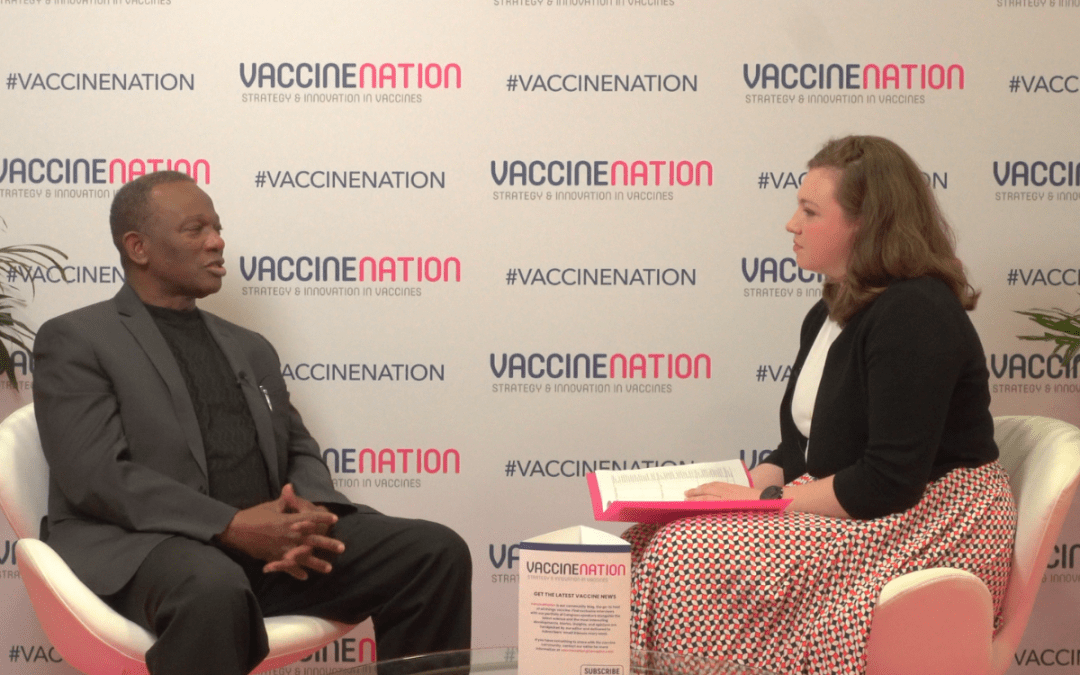
Our next interview from the Congress in Washington features Merck’s Dr Jules Millogo, who joined us for a panel in the Vaccine Supply and Logistics track: Partnerships between industry and vaccine implementation programmes. Dr Millogo is another of our interview returners, so we were glad that he was happy to join us again to continue the conversation started last year! A public health physician, Dr Millogo currently works with Merck’s Vaccine Division as WHO Liaison.
Industry meets implementation
We first asked Dr Millogo for some insights into his panel on industry and implementation programmes. His main concern, which he believes is shared by others, is that vaccines are “still not reaching where the disease prevalence is highest in the world”, despite the availability of safe and effective vaccines. Dr Millogo’s role, therefore, is to “attract the attention” of company leaders to ensure there are mechanisms to reach all populations, and to work with governments and international organisations to prioritise the introduction of these vaccines. However, he notes that this role is complicated by specific challenges, such as civil wars or other diseases.
“It’s not necessarily that people are not willing; they’re just overwhelmed.”
Thus, Dr Millogo identifies the need to “facilitate” and ensure that “products that are lifesaving reach those who need it”.
Overcoming obstacles
Our next question considers the key obstacles in place to preventing access to essential vaccines. Dr Millogo suggests that “sometimes the challenges are purely logistics”. For example, he refers to his country of birth, in which travelling 50 miles can take 2 or 3 hours by bicycle or motorbike, and is complicated by a lack of electricity or personnel.
“Those infrastructure challenges can be there.”
A further “barrier” is government prioritisation; Dr Millogo considers the 2006 FDA approval of HPV vaccination, which is now available in “most” high-income countries. However, only 26% of eligible girls are vaccinated. Another cause for concern for Dr Millogo is “zero-dose children”, who miss out on essential vaccines, some of which have been around for many years.
“This is not acceptable. This is something that we all should be concerned about, and make sure we address these barriers.”
While there is progress, we “still have a way to go”, says Dr Millogo; diseases such as measles and polio are “still out there”.
“When you look at the world as it is…we are on the same planet but there are still areas of the planet where it’s a different world really.”
Communication is key for the vaccine field
In our previous interview, Dr Millogo highlighted the life-changing power of trust and effective communication. We asked how receptive the community is to this message.
“It’s really a challenge for us as physicians, public health experts, to adopt the language that people can trust and rely on.”
Dr Millogo reflects that it’s “not intuitive”, and shares that, as a graduate of medical school, even he struggled to keep pace with some of his colleagues at the event. In his experience, it has to be simpler.
“You can really explain in very simple terms; you have to be able to explain to a 5-year-old that the disease is bad and the prevention is good…you don’t need to put in so many expert words.”
For Dr Millogo, this is something that “we have to work harder”.
“Be mindful as ‘experts’, as physicians, or as researchers, or academics, that sometimes we are not the best at communicating this information. We can use more tools.”
Why WVC?
As always, we conclude by inviting our experts to share their reasons for joining us at the event. For Dr Millogo, it’s the opportunity to “make connections that you wouldn’t otherwise have”.
“Here you meet other industry partners…and establish connections that can help really to facilitate access to the products.”
For some of the smaller biotechs, visibility can increase at these events, which means people like Dr Millogo can support their efforts to get interventions to the people who need them most.
“At the end of the day, it’s the human connection that we are all trying to work towards a common goal where people don’t die from preventable causes…we shouldn’t see that anymore.”
We hope that it was a productive event for Dr Millogo, and that you enjoy hearing from him again! To learn about another aspect of his work with the Konkourona Alliance Foundation, click here.
For more conversations with our experts from the Congress in April do make sure you subscribe for weekly updates here!