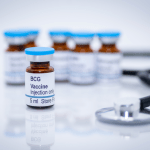
In August 2024 a paper in Disease Models and Mechanisms presents research that uncovers the earliest cellular mechanisms involved in tumour clearance induced by the Bacillus Calmette-Guérin (BCG) vaccine. Initially developed for use against tuberculosis (TB), the BCG vaccine is the “oldest cancer immunotherapeutic agent in use”. However, little is understood about its initial mechanisms of action. Thus, the authors developed an in vivo assay to visualise the interactions between bladder cancer cells, BCG, and innate immunity in real time and at single-cell resolution.
BCG
BCG has been used as a cancer immunotherapeutic agent for years and is the “most effective treatment to avoid disease relapse” in bladder cancer. Intermediate or high-risk non-muscle-invasive bladder cancer (NMIBC) tumours are treated with intravesical BCG immunotherapy around 2 weeks after transurethral resection. The therapy involves 6 weekly instillations, followed by maintenance therapy of 1 to 3 years. However, this approach has a high rate of adverse effects, the supply chain has worldwide shortages, and some patients are resistant to treatment.
The authors highlight that the mechanisms through which BCG induces anti-tumour activity are “not fully understood” and that BCG therapy has remained “mostly unchanged”. Previous research proposed a multi-step model:
- In steps 1 and 2 BCG binds to and invades the bladder lumen, interacting with the urothelium and tissue-resident macrophages.
- In step 3 BCG is internalised by immune cells and induces an innate immune response that triggers a strong local induction of pro-inflammatory cytokines and chemokines. This stimulates the recruitment of immune cells. Macrophages and other antigen-presenting cells present BCG antigens to T lymphocytes through the major histocompatibility complex class II and trigger an adaptive immune response.
- In step 4 therapy is considered successful if the induction of the adaptive immune response is biased towards Th1 cells. The recruitment of these immune cells leads to the development of granulomatous lesions in the bladder wall.
The zebrafish model
Assessing treatment response in patients is challenging, so animal models of bladder cancer have been used, such as mice. Although mice are considered the “gold-standard xenograft model” for their “highly conserved genetic likeness with humans”, the model has disadvantages. An alternative is the zebrafish; similarities in molecular pathways and drug responses between zebrafish and humans and the “ease in genetic manipulation” allow for “robust” cancer models.
“In zebrafish cancer xenografts, where human tumour cells are injected into zebrafish embryos or adults, cancer features such as proliferation, angiogenesis, metastasis, and interactions in the tumour microenvironment (TME) can be rapidly visualised in real time and at the single-cell level due to the optical transparency of the model.”
Research in zebrafish xenografts “facilitates the rapid identification of novel cancer mechanisms that can be targeted by specific therapeutic approaches”. Additionally, the zebrafish model has supported human tuberculosis research.
The study
The researchers used real-time single-cell-resolution microscopy to demonstrate in vivo in a bladder cancer zebrafish xenograft that BCG immunotherapy “induced cancer cell apoptosis and clearance of tumours through macrophages and TNF signalling”. BCG stimulated a “massive recruitment of macrophages” that were polarised towards a Tnfa-positive pro-inflammatory phenotype.
High-resolution live microscopy revealed that the presence of BCG in the TME induced “profound changes” in macrophage morphology and cell-cell interactions. Without innate immune cells, tumour clearance was “halted”, which demonstrates their importance to BCG’s anti-tumour effects. The authors also demonstrated the utility of their xenografts in a preclinical setting, testing the efficacy of a newly genetically modified BCG vaccine against the conventional BCG vaccine.
Dr Mayra Martínez-López, first author, suggests that BCG immunotherapy is “still rather empirically used”. It is a “very effective immunotherapy” even in comparison with “so many fancy immunotherapies that are being developed”.
“Not only did we unravel the mechanisms involved in the first steps of the vaccine’s anti-tumoral action, we also demonstrated that the zebrafish Avatar model is a powerful preclinical tool for drug discovery in oncology.”
To join discussions about innovative immunotherapies and cancer vaccine strategies, get your tickets to the Congress in Barcelona this October. Don’t forget to subscribe to our weekly newsletters here.