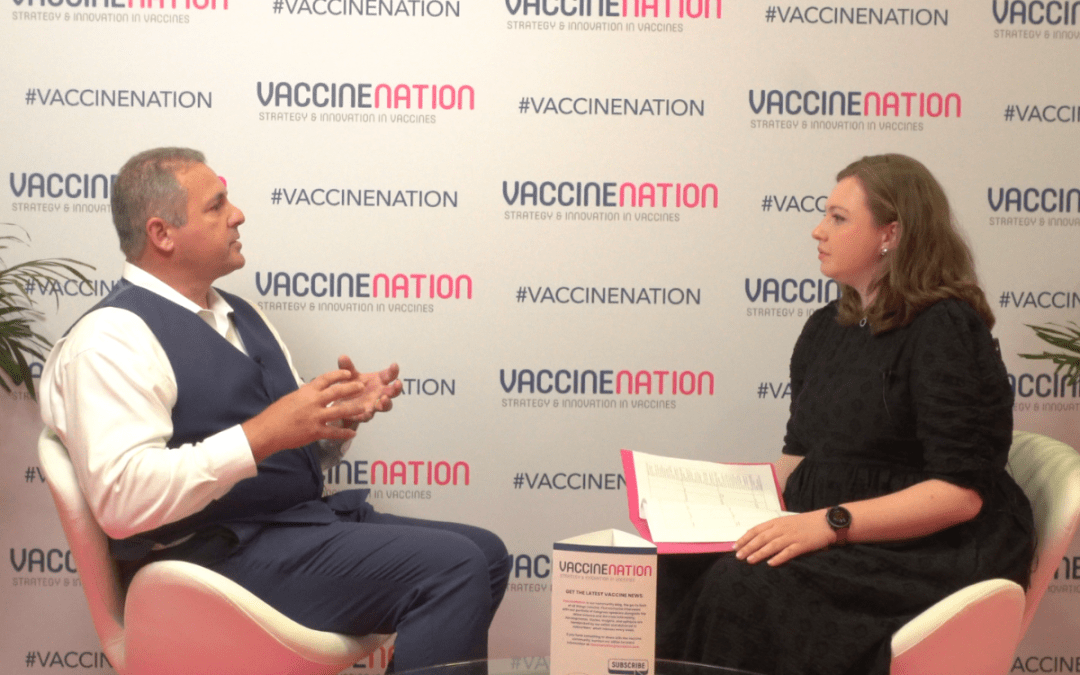
Next in our interview series from The World Vaccine Congress in Washington is a conversation with Integrum Scientific‘s Joe Sgherza; we were glad that he was happy to return to the interview zone to continue the conversation that we started in Washington last year. As Chief Executive Officer, Joe works with the Infectious Disease Board and Operations team on readiness response to pandemic infections across the globe. Founded out of the Ebola crisis in 2014, Integrum brings together many former colleagues to address global gaps and be ready to “call out to arms”. Joe kindly gives us an insight into the important work his team is doing, and you can learn more here.
As a global readiness organisation, Integrum’s work is “very upstream” of some of the vaccine development work taking place at the Congress. However, it’s important to “talk about the efforts that Integrum people play in the field”, providing serum collection for subjects who have been cured of various infectious diseases. This is useful to organisations such as CEPI, with whom Integrum is working closely.
“We can bank the purest samples…so that they can do further research and eventually get a vaccine.”
Working with affected communities
As Joe outlines the way that his team works, taking samples from persons affected by infectious diseases, we asked about engaging these communities in this work, and how the Integrum team operates in different countries. He explains that the advisory board comprises scientists and “thought leaders”, who are “trusted in each one of these countries”. Their impact is realised as they reassure subjects on the work that is to be done with their samples.
“We take [informed consents] very seriously.”
Joe highlights that, as the team is not delivering an intervention to the participants, it’s important to explain how their blood will be used and “how the progress is doing”. He offers the example of Rift Valley Fever, which has now progressed to a new project with CEPI.
Progress matters
Acknowledging the importance of communicating progress to participants, we asked Joe to explore this in greater detail for us. He considers the example of Uganda, where Integrum has a “sentinel” in Dr Julius Lutwama, who joined us in the interview last year. Integrum is able to share updates with participants, but “a lot of the difficulty” is reaching more remote regions and securing the necessary approvals to move and store samples. This is where the global network, including experts like Dr Lutwama, i
Why WVC?
Finally, we asked about what brought the Integrum team to the Congress. Joe suggests that a booth provides “many advantages”, not least meeting colleagues. For example, he was able to meet an investigator who is “interested in getting his research off the ground”, the perfect case for Integrum:
“We help people develop a project plan; we put them in touch with people like our Infectious Disease Board, and then we work with other CROs, other individuals and organisations such as ours, so that we can get the science propelled into actually a programme.”
It’s great to hear that these early steps in future projects are taking place at our event, and we hope that the Integrum team enjoyed their time with us. We were glad to speak to Joe again and hope that you enjoy the interview!
For more conversations with our experts from the Congress in April do make sure you subscribe for weekly updates here!