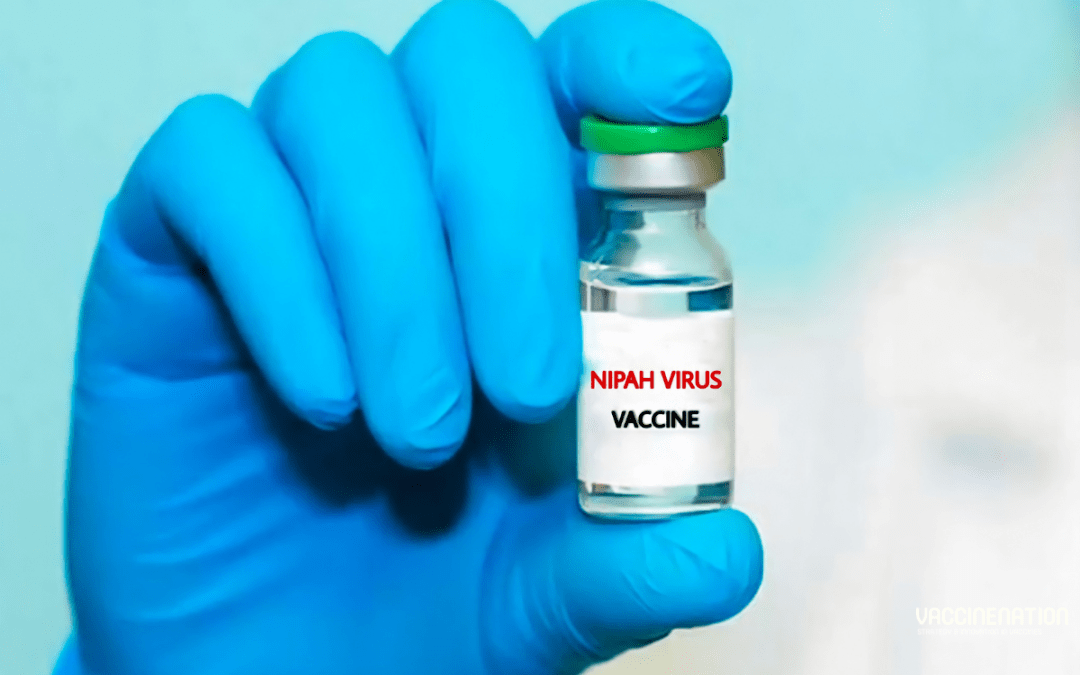
A study shared as a The Lancet preprint in May 2024 presents the results of an evaluation of a potential Nipah virus (NiV) vaccine. The recombinant subunit vaccine uses a soluble version of the Hendra virus (HeV) attachment G glycoprotein (HeV-sG-V) due to similarities with NiV. In a Phase I study in adults, researchers found that the vaccine candidate was safe and immunogenic, with “potential for reactive outbreak control and preventative use”.
Nipah
Nipah virus (NiV) was first isolated in 1999 after an outbreak in pigs and humans in Malaysia and Singapore. It is “closely related” to Hendra virus (Hev), another “highly pathogenic” paramyxovirus of the Henipavirus genus. NiV’s natural reservoir is the fruit bat, and human infections can occur after consumption of fruit or date sap contaminated with bat saliva or urine. Cases of human-to-human transmission have also been reported. Although the estimated transmission rate for NiV is “low”, infection is associated with mortality rates of 40%-70%.
Two strains have been identified: NiV Bangladesh (NiVB) and NiV Malaysia (NiVM). Studies have indicated that the former is more pathogenic.
“The potential for large outbreaks and the high mortality, along with no effective treatment options, has motivated development of an effective vaccine against NiV infection.”
This would be particularly useful to protect medical personnel and close contacts of cases in an outbreak, as well as “military and civilian personnel threatened by weaponised versions of the viruses”. Furthermore, a vaccine that provides long-lasting immunity would be “valuable” to those living in endemic areas or working on NiV or HeV research.
The study
The article presents the first-in-human Phase I evaluation of the safety, tolerability, and immunogenicity of an HeV-sG-based vaccine candidate (HeV-sG-V), developed for the protection of humans against NiV. The investigation was a single-centre, randomised, placebo-controlled, observer-blind study conducted in the US. 192 participants were enrolled and 173 met per-protocol criteria. They were randomised in three dose-escalation cohorts of 10mcg, 30mcg, or 100mcg, and placebo.
“All doses and regimens were found to be safe and tolerable.”
The most commonly reported adverse event was “mild to moderate injection site pain”, and adverse event frequency increased as the vaccine dose increased. However, the authors not that this was “transient, and, at most, of moderate severity”. Although fatigue and headache were reported, myalgia and “feverishness” were “unusual”.
“All dosages of HeV-sG-V were found to be immunogenic, with a clear dose-dependent immunological response when the 100mcg dosage was compared to the 30mcg administered in similar schedules.”
Compared to the single-dose regimen of 100mcg, two-dose schedules “resulted in a strong anti-NiV immune response”. When administered 7 days apart, the two-dose regimen led to a “steeper rise in antibodies”, but two 100mcg administrations 28 days apart “elicited a higher immunological response”. Persistence of a “robust” immunological response and a strong anamnestic response from the two-dose 10mcg regimen delivered 6 months apart indicated that a boost response could be expected.
As WHO recommends that a NiV vaccine should be indicated for all age groups and populations at high risk, the authors suggest a need for additional studies to expand the indication for the vaccine. These studies should take place in “larger and broader populations” in countries “regularly affected” by NiV outbreaks.
For more on infectious disease control through innovative vaccine strategies, why not join us at the Congress in Barcelona this October or subscribe to our weekly newsletters here?